

How GSR works
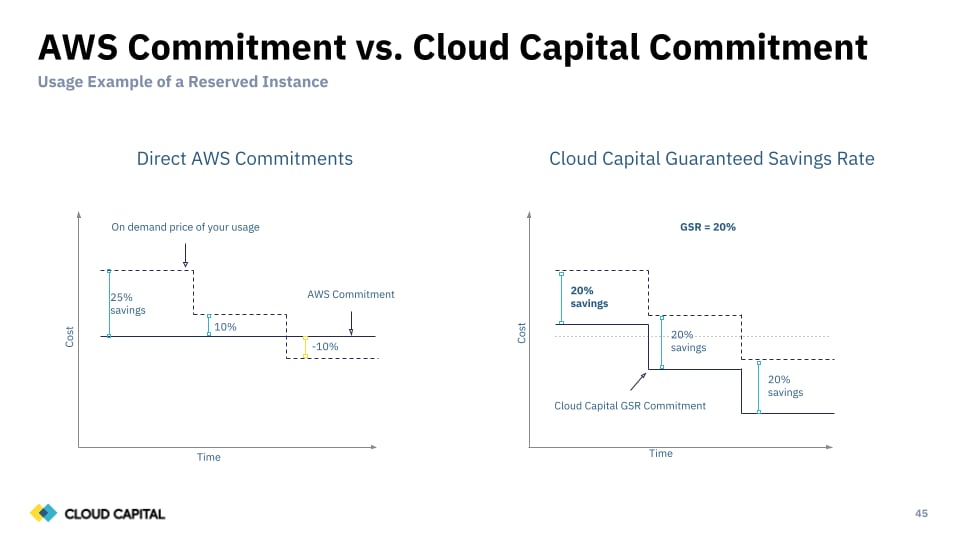
AWS offers significant discounts when you commit to a minimum level of spend over 1 or 3 years, through Savings Plans and Reserved Instances. The challenge is that those commitments carry risk: if your usage drops, you still owe the committed amount. Cloud Capital solves this by purchasing and holding those commitments for you. We absorb the financial risk of underutilization and pass through the savings as a guaranteed rate. You benefit from long-term AWS commitment discounts without taking on the commitment exposure yourself. For every commitment Cloud Capital purchases on your behalf:- Your GSR is fixed at the time of purchase and does not change for the term of that commitment
- You only pay for the portion of the commitment you actually consume
- If your usage falls short of the committed amount, Cloud Capital absorbs the cost of the unused portion — you receive a GSR Rebate credit for the difference
- The GSR applies only to the committed portion of your spend, not your entire AWS bill
The GSR is specific to each individual commitment. When you have multiple commitments active, Cloud Capital calculates a weighted average GSR across all of them based on the spend each commitment covers.
What GSR covers
GSR applies to spend covered by commitments — Savings Plans and Reserved Instances. It does not apply to On-Demand spend that falls outside of commitment coverage. If you are an AWS Billing Transfer customer with Cloud Capital, you may also receive a Cloud Discount — a separate fixed percentage reduction on your total monthly AWS spend. Cloud Discount is additive to GSR: it applies to a broader portion of your bill and is calculated independently.A simple example
Suppose Cloud Capital purchases a Compute Savings Plan on your behalf with a GSR of 38%.
The 38% savings rate is guaranteed for the full term of the commitment. The dollar saving will vary with your actual usage — but the rate never changes.
This distinction matters. With an AWS direct commitment, the listed savings figure is the best-case scenario: it assumes you fully utilize the commitment. If your usage falls short, your effective savings rate declines — and in the worst case, you pay above On-Demand price for capacity you committed to but did not use. With a Cloud Capital GSR-backed commitment, 38% is the only scenario. Cloud Capital absorbs any shortfall and issues a GSR Rebate credit for the unused portion — you always save 38% of what On-Demand would have cost you.
GSR vs Effective Savings Rate
These are two distinct metrics that are easy to confuse:
Your ESR will typically be lower than your GSR because it includes On-Demand spend that is not covered by commitments. As your commitment coverage grows over time, your ESR moves closer to your GSR.
How GSR appears on your invoice
GSR activity appears as two line items on your Cloud Capital invoice each month:- Guaranteed Savings Rate Fee — the charge for Cloud Capital’s commitment management service, calculated as a share of the savings delivered
- Guaranteed Savings Rate Rebate — a credit issued when your actual usage falls below the committed level, ensuring you only pay for what you consumed
Risk transfer: what happens if your usage changes
AWS commitment risk works in one direction: if you commit to a fixed monthly spend and your usage drops, you still owe the full committed amount. Managing this risk independently requires either over-committing (and losing money on unused capacity) or under-committing (and missing out on discounts). Cloud Capital changes this equation. Because we hold the commitments in a dedicated account on your behalf, the financial exposure belongs to us — not you. If your usage drops unexpectedly due to a workload migration, a product change, or a seasonal shift, Cloud Capital absorbs the cost of the unused commitment and issues you a rebate. The forecast is what makes this possible at scale. The more accurately your forecast reflects your future spend, the more precisely Cloud Capital can size your commitments — maximizing your GSR coverage without over-committing. This is the core advantage of Cloud Capital over managing AWS commitments directly: your savings rate is guaranteed, your risk is absorbed, and your commitment levels stay calibrated to your actual business as it evolves. Cloud Capital continuously monitors utilization and adjusts future commitment proposals accordingly.Cloud Capital maintains a financial reserve specifically to cover underutilization risk across all customers. This reserve is the structural backing for the GSR guarantee.